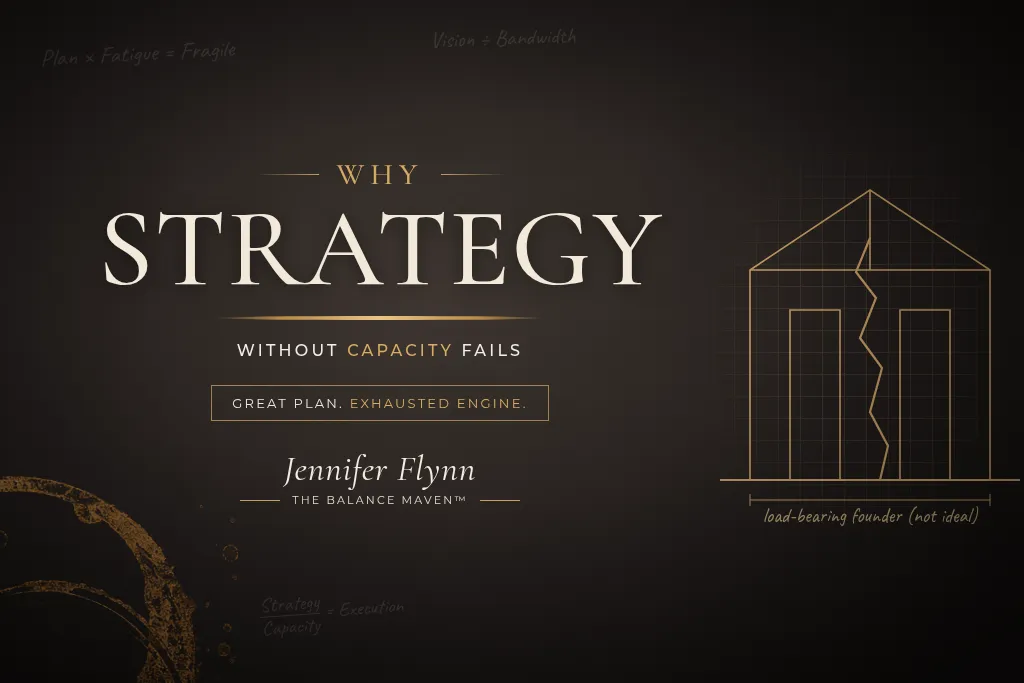
Why Strategy Without Capacity Fails
Because even the best strategy breaks inside a system the founder can no longer sustainably carry.
By Jennifer Flynn | THE BALANCE MAVEN®
Founders love strategy.
Honestly? So do I.
I love clean operational design, smart positioning, scalable systems, elegant business models, strategic clarity and momentum that actually makes sense.
But here’s the problem. A brilliant strategy cannot save a founder whose internal infrastructure is collapsing underneath it.
And this is where a lot of businesses quietly start wobbling. Because strategy gets treated like the answer to everything.
Revenue slow? More strategy. Team issues? More strategy. Scaling problems? More strategy.
Exhausted founder who hasn’t felt emotionally present since 2021? Apparently another Notion board and a quarterly planning retreat should fix it.
That’s not strategy. That’s corporate fan fiction.
Strategy assumes the founder can sustain the load
This is the part nobody says out loud enough. Every strategy creates demands. Operational demands. Leadership demands. Emotional demands. Energetic demands. Decision-making demands. Complexity demands.
And eventually every business strategy collides with one unavoidable question:
Can the founder sustainably carry this version of the business?
Bring the team into that question, too. Who owns the next move? What can they decide without you? What still lands on your desk? If the plan needs you in every room, it has not accounted for the human carrying it.
Because if the answer is no… the strategy eventually breaks too.
Not because the founder is weak. Because no system can sustainably outperform the human leading it forever.
Capacity is the missing business metric
This is one of the biggest blind spots in modern entrepreneurship. Businesses track profit, growth, efficiency, performance, productivity and conversion rates. Meanwhile nobody tracks founder depletion, emotional bandwidth, decision fatigue, invisible exhaustion, relational sustainability, cognitive overload and leadership recovery capacity.
So founders keep scaling businesses while quietly shrinking themselves to hold them.
And eventually the cracks start appearing… reactive leadership, poor decisions, resentment, team instability, emotional volatility, stalled creativity, constant firefighting and loss of strategic clarity.
Not because the founder suddenly became incapable. Because the system became unsustainable.
High performers are especially vulnerable to this. Why? Because capable people can survive broken systems longer than most. You become adaptable, responsive, resilient, emotionally self-overriding and excellent under pressure. Which means you can keep the business functioning long after the cost becomes unhealthy.
That’s dangerous.
Because eventually the founder becomes the bottleneck, the emotional support beam, the regulator, the compensator and the invisible infrastructure holding everything together. At that point, strategy stops being expansion.
It becomes survival architecture.
Strategy without capacity creates fragile growth. This is why some businesses look wildly successful from the outside… while internally everything feels one missed email away from combustion.
The founder is exhausted, overextended, constantly reactive, carrying emotional labor invisibly, unable to fully disengage and operating without enough recovery or spaciousness. And the strategy keeps demanding more. More launches. More growth. More scaling. More complexity. More visibility. More output.
Eventually the business becomes like adding another floor onto a building with foundation cracks.
Impressive? Sure. Concerning? Also yes.
Capacity creates strategic stability
This is the shift. Founders who prioritize capacity build differently. Not smaller. Not softer. Differently.
They begin asking, can this business model support an actual life? Does this growth require chronic depletion? Is this operationally sustainable? Does this leadership structure preserve clarity? Can success exist without self-erasure?
That changes everything.
Because sustainable scaling requires strategic alignment, operational support, emotional sustainability, founder capacity, recovery and realistic energetic demands. Not just “better execution.”
The goal is not less ambition. Let’s retire that assumption immediately. This conversation is not anti-growth. It’s anti-building-success-that-quietly-destroys-the-founder.
Different thing.
The goal is sustainable expansion, clear leadership, strategic depth, healthy operational infrastructure, meaningful impact and businesses that give more than they take.
Because eventually the smartest strategy in the world still fails if the founder cannot sustainably survive the life required to maintain it.
And if success demands chronic self-abandonment just to keep scaling?
The math doesn’t math.
If your business strategy looks strong on paper but your actual life feels increasingly unsustainable, it may not be a strategy problem alone. It may be a capacity problem.
A great plan you can't carry is a nice document. If the strategy is solid and the founder is running low, book a Founder Reset Session and we'll build a first move you can actually sustain.
