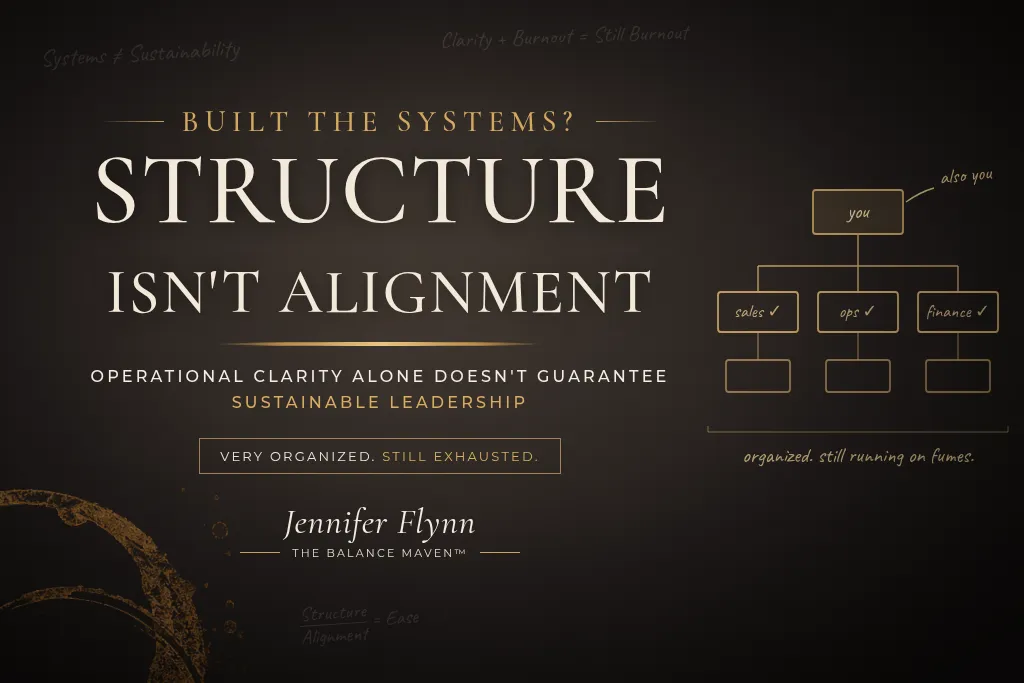
EOS Built Structure. Founders Still Need Alignment.
Because operational clarity alone does not guarantee sustainable leadership.
By Jennifer Flynn | THE BALANCE MAVEN®
Let me say this first before the internet decides I’m lighting a flipchart on fire in a parking lot somewhere: operational systems matter.
Deeply.
In many ways, systems like EOS changed modern entrepreneurship for the better. They brought structure, accountability, operational clarity, process discipline and leadership alignment. They brought traction to chaotic businesses. That mattered. Still matters.
Because a surprising number of businesses are basically being held together with caffeine, vibes, and one emotionally exhausted founder whispering, “Don’t collapse today, I’m begging you.”
Operational systems solve real problems. But here’s the conversation I think founders are finally ready to have.
A business can become operationally healthier… while the founder quietly becomes personally unsustainable underneath it.
That’s the gap. And honestly? It’s becoming one of the biggest leadership conversations of the next decade.
Operational systems solved a massive problem
Before systems became mainstream, many founder-led companies ran on reactive chaos, tribal knowledge, emotional decision-making, unclear accountability, founder dependency and constant firefighting.
Everything lived in the founder’s head. Nobody knew priorities. Meetings multiplied like gremlins in water. And every problem somehow became the founder’s emotional support project by Thursday afternoon.
Systems changed that. Frameworks like EOS brought structure, cadence, accountability, process, operational consistency and clearer leadership execution.
That’s valuable. Very valuable. And frankly? A lot of businesses desperately need more structure, not less.
But structure alone doesn’t solve the founder problem
This is the part people are beginning to realize.
A founder can implement systems, scorecards, processes, accountability charts, strategic planning rhythms and leadership structures… and still feel exhausted. Emotionally overloaded. Invisibly exhausted. Chronically over-responsible, disconnected from life outside the business, and unable to sustainably hold the weight of growth.
Why?
Because operational systems measure business performance extremely well. But they often do not measure founder capacity, emotional sustainability, Return on Energy™, leadership bandwidth, invisible labor, chronic self-override, relational cost, or the long-term sustainability of the human leading the company.
And eventually that matters. A lot.
This is the hidden reality in many “successful” businesses. The systems exist. The org chart exists. The meetings exist. The processes exist.
But beneath all of it? The founder is still carrying emotional weight invisibly, making too many decisions and absorbing operational pressure. Still functioning as the nervous system of the company, compensating for leadership gaps, self-overriding to maintain momentum.
Which means the business becomes operationally cleaner… while still emotionally dependent on the founder’s depletion.
That’s not sustainable scaling. That’s structured exhaustion.
Try this at your next leadership meeting. Pick one decision that keeps coming back to you. Ask who owns it, what they are allowed to decide and when they actually need you. An org chart can name a seat. The people in it still need room to lead.
Very organized. Very impressive. Still exhausting.
The missing layer is founder sustainability
This is the shift I believe we’re moving into now. Not abandoning operational systems. Evolving them.
Because founders today are facing a different layer of complexity: emotional overload, decision fatigue, constant accessibility, leadership isolation, visibility pressure, scaling complexity, invisible exhaustion, and businesses expanding faster than the founder’s capacity to sustainably hold them.
That requires more than process discipline. It requires capacity-aware leadership, emotionally sustainable operations, human-centered scaling, strategic clarity, recovery, and operational design that supports the founder instead of consuming them.
This is the exact gap that eventually led me to begin developing what became Empire Ops™. Not as a rejection of operational structure. As an expansion of the conversation.
Because businesses don’t just need systems, process, accountability and execution. They also need sustainability.
Honestly? I think the next evolution of leadership is not hustle vs balance, structure vs intuition, or operations vs humanity.
It’s integration.
The founders who scale best long term will likely be the ones who build strong operational systems, sustainable leadership structures, emotionally intelligent decision-making, healthier growth models… businesses that give more than they take.
Because eventually, even the cleanest operating system in the world cannot sustainably compensate for a founder who is quietly disappearing beneath the weight of the business.
And if success still requires chronic depletion just to maintain momentum?
The math doesn’t math.
If your business has structure but your life still feels increasingly unsustainable, the missing issue may not be strategy alone. It may be founder sustainability.
Your systems are tidy, so let's check on the human running them. An honest look at founder capacity comes first, and the Founder Clarity Diagnostic™ is where that look begins.
